
We’ve faced a few problems when sharing household tasks. I’ll describe the problems, they’ll probably sound familiar to you.
Problem 1: DIFFERENT TIMETABLES
I’m a procrastinator.
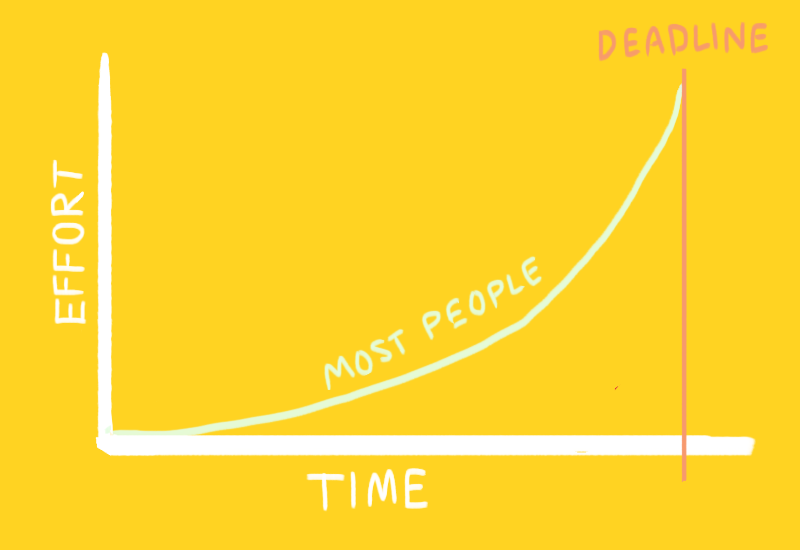
Not an extreme procrastinator, mind you: I always get things done, but I tend to get them done in condensed time period. If a normal person’s productivity curve looks like this:
Then mine looks like this:
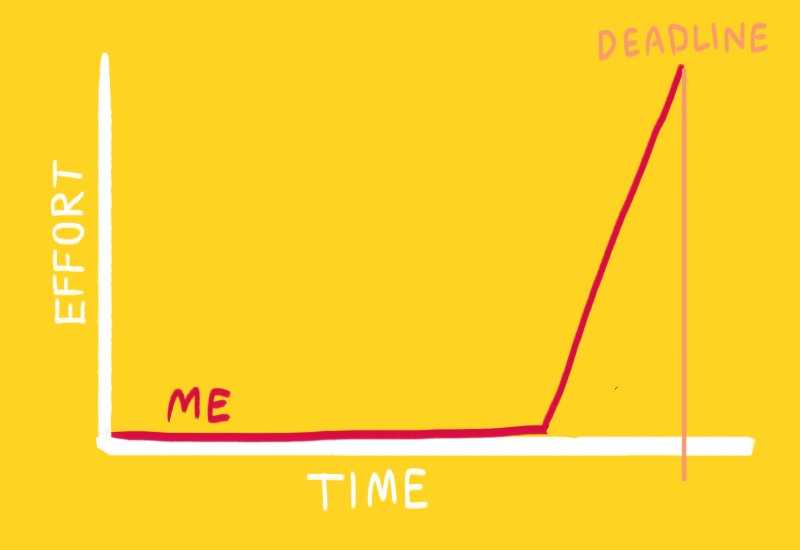
I get everything done, but in a shorter, intense period of time. It doesn’t cause me stress if I leave things until the last minute – in fact, it gives me the motivation I need to handle mundane tasks. In the final hour before people come to our house, for example, I find depths of dedication, focus, and intensity that I don’t have three hours before they come.
My amazing wife Sonia, has a different productivity curve. She’s a PREcrastinator.
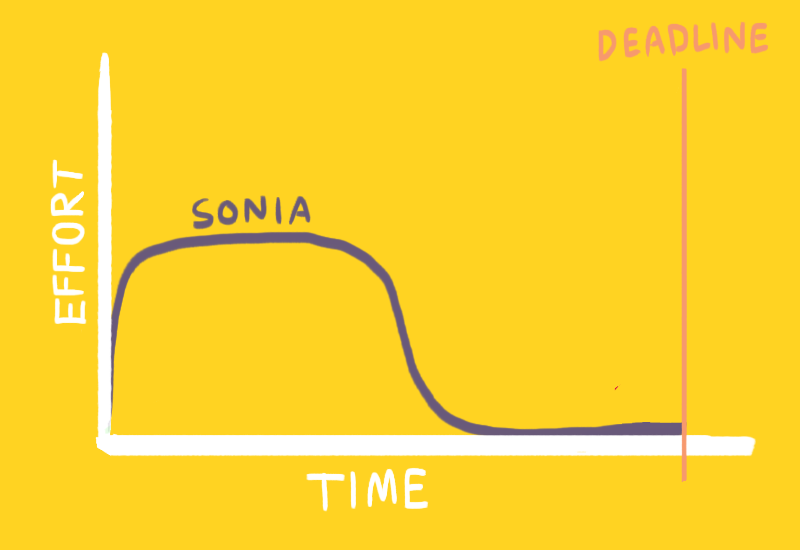
She’s what Adam Grant calls a PREcrastinator: a person who gets everything done as soon as possible, because leaving things until the last moment stresses them out.
You can probably see the problem here.
If we both stick to our natural ways of working, things don’t look good:
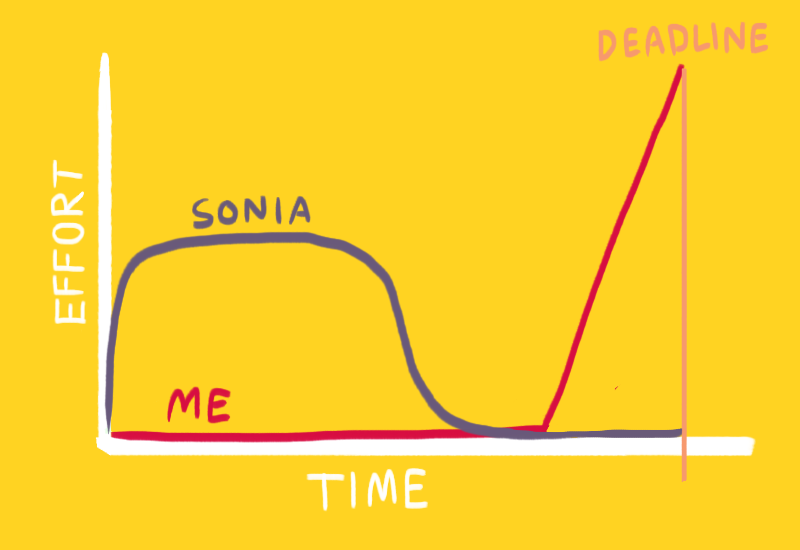
She really wishes I would stop delaying and get to work. I wish she would relax, enjoy the time we have. This is a very common dynamic in marriage.
If she pushes me to comply to her schedule, I drag around, getting everything done extremely slowly, having exactly zero motivation. I feel like she’s a little too tightly wound. If I try to get her to do things on my schedule, she’s stressed to the max, because to her it feels like we’re leaving things until the last minute.
When this happens in a marriage, it usually plays out the same way: he intends to help prepare the house for company, but by the time his motivation kicks in, she’s already gotten everything done. She usually drops passive-aggressive hints. He usually ignores them (Come on, we’ve got plenty of time!) content with being resentfully useless and letting her get everything done.
Problem 2: STANDARDS
There’s another problem beyond our different timetables: we have different standards.
This applies to many aspects of life, but let’s stick with the cleanliness example: Sonia has a different definition of an acceptably clean house than I do. Even if I help out, I often doesn’t do things as well as she’d like, so she ends up re-doing many tasks. She asks me to clean the bathroom, I get it acceptably clean, according to my standards. It’s not acceptably clean in her eyes, so she wipes everything down afterward. I feel like she doesn’t appreciate my help, and next time I’ll do a worse job at cleaning the bathroom: why try when she’s just going to re-do everything?
Sonia feels like I’m not even trying, and every time she asks for help, she gets shoddy work, done grudgingly. Every time I help out, I feel like a kid who doesn’t know how to clean properly, and needs a grown-up to clean up after me.
Problem 3: CLARITY
She knows what needs to be done. I sort of know, but not really. I’m more likely to forget half the things, and improvise later (oh, I didn’t pick up pasta sauce! That’s OK, buttered pasta it is!).
Most husbands just want to be clearly told what needs to be done, and most wives expect him to just know. She might be trying not to nag him, but he needs some clarity. Clear, even blunt communication is the best way to communicate with your husband. When there’s a lack of clarity, Sonia ends up picking up the slack: she sees more problems than absent-minded me.
These are the problems: different timetables, standards, and conflict over clarity. If you’re married, you’ve most likely faced this kind of thing.
Right, what to do? Should I get more responsible? Should she chill out and learn to relax? Sonia and I have figured out a solution that works really well.
A COMPROMISE
Now I’ll illustrate the solution we’ve come up with. We have figured out how to deal with our different timetables and different standards, without all of the friction, conflict, and grumpiness. We have a fair division of labor, sufficient clarity, and we get everything done.
Let’s say we’re preparing for our weekly game night: people arrive at our house at 2:00.
-
Sonia already has a running list of everything that needs to be done in her head. This happens, like, right away in the morning somehow.
-
I go to her, and ask for a list of what she wants me to get done.
-
I write everything down (because clarity is really helpful) and we go over the list together: if I get everything done on this list, is it a fair amount of work? Will she have enough time to get all of her tasks done without being stressed out?
-
We make sure to get EVERYTHING on the list, and then we make a small agreement: I promise to get everything done, to her satisfaction, by the time people come at 2:00. Even if I’m racing around like a madman at 1:48, I promise to get everything done. She agrees to let me complete the tasks on my timetable, as long as it’s done by the deadline.
-
If I don’t get the list done by 2:00 (or if I don’t get the tasks done according to her standards) then she is within her rights to take me to task, and I’ll admit my failing and make it right. She’s got higher standards, so I defer to those standards.
Here are the guidelines when setting up this agreement for yourselves:
CLEARLY dole out tasks, and write them down.
Clarity is important. You don’t want the her to be resentfully doing more than their share. It’s too often the case that the she just does everything that needs to be done, because she knows what needs to be done, and it’s easier for her to do it herself. If you clearly write down tasks, he knows what he is responsible for, and she knows what she’s NOT responsible for.
Have a clear deadline: the exact hour when the tasks MUST be done. Then allow for different timetables.
Having a clear deadline is really important. “As soon as possible” is not a deadline. She must set a deadline that she doesn’t find intensely stressful, and then leave the him to work on his timetable.
Defer to whoever has higher standards.
If you’ve got lower standards then your spouse, it’s usually a good idea to commit to their standards. Example: I’m terrible at sweeping. I go over the floor multiple times, and yet somehow I leave crumbs everywhere. I’ve had to learn how to slow down and do a better job, because Sonia had higher standards for floor cleanliness than I.
She doesn’t ever to re-do his tasks. If he didn’t do a good job, she has to ask him to re-do the task.
Right, but what happens if I slack off and don’t do the job right?
What used to happen: Sonia would re-do it. She would feel resentful that I didn’t do it right. I would feel like a little kid who needs to be picked up after. Not a good solution.
What happens now: I’m totally responsible for my tasks, so if I don’t do a good enough job, Sonia isn’t allowed to re-do it. She has to ask me to re-do it, and I have to comply with a minimum of complaining.
This means that Sonia doesn’t end up with extra work if I don’t do a good job, and I’m heavily incentivized to FOCUS and do a good job, because it’s mildly embarrassing when I can’t manage to sweep properly.
She shouldn’t keep him on on task.
She’s allowed to take the procrastinator to task for not fulfilling his obligations if and only if he fails to get the jobs done within the time limit. He’s free to do the tasks on his timetable, and she must assume that the tasks will get done without any more of her input. This means there’s no need to mention the tasks. She must assume the procrastinator will be getting everything done. This means if she reminds him of his responsibilities before the deadline, he must gently remind her that the deadline isn’t here yet, and that she may take him to task if he oversteps the deadline.
The Procrastinator must get done on time, with high standards.
If he doesn’t, he must humbly and politely accept criticism, and work hard to fix the problems, get the tasks done. No griping allowed, because you agreed to the tasks and deadline. She’s only holding you to your agreement.
He must accept that he’ll have to redo some stuff and get better at things he’s bad at.
If you’re the low-standards partner, you’ll have to humbly accept input from your spouse who is much more talented at preparation. Sometimes you’ll need to redo things, or get better at childishly simple things. Accept this with a minimum of embarrassed grumpiness.
—-
Try this out. It will seriously reduce the amount of conflict around household tasks, and you might even be able to avoid being that cliche of the nagging wife and the lazy husband.
None of us wants our marriages to look like that.